

Transport
Working towards a ban on live animal transport
Every year, billions of animals are transported over thousands of kilometres - by air, sea or land - to be slaughtered or fattened for slaughter. During these journeys, they suffer tremendously due to stress, exhaustion, over-heating and injuries. Even unweaned calves are transported from the age of 14 days on long journeys, suffering hunger, thirst and thermal stress which heavily impacts their weak immune system. Nor is any special care given to pregnant animals, who sometimes end up giving birth in terrible conditions on board vehicles or ships.
FOUR PAWS is working intensively to change existing legislation to put an end to cruel long-distance live animal transports to third countries.
Why and how do animals suffer during transport?
- The maximum loading density is exceeded, which does not allow animals to rest in normal position
- Insufficient height inside vehicles, especially for cattle in double-decker trucks
- Maximum permitted transport time is often exceeded and mandatory resting stops do not take place
- Temperature limits inside the vehicle are exceeded (>30°C and <5°C)
- Unsuitable loading ramps, often too steep and slippery
- Lack of suitable equipment for feed and water, particularly during transport of young, unweaned animals
- Transport of animals that are unfit for travel due to sickness and/or broken limbs
- Transport of heavily pregnant animals
- On-vehicle fights between animals originating from different stables
- Rough handling of animals during loading and unloading, leading to intense stress, fear and serious physical injuries
- Poorly trained staff and badly paid drivers, leading to reckless driving
- Missing control posts and resting stations in third countries
What are we doing about this?
- Together with other animal welfare organisations we are lobbying at European level for a revision of EU Transport Regulation 1/2005 to put an end to long-distance transport of live animals
- We are calling for full compliance of existing regulations and consequential sanctions when infringements are obvious as first steps until live animal transport is effectively banned
- We continuously present our science-based demands and recommendations for animal welfare improvement in live animal transport to the European Parliament and Commission
FOUR PAWS calls on:
- A ban on live animal transports to third countries
- A ban on live animal transports by sea
- A ban on transport of unweaned animals
- No animal transports in temperatures below 5°C or above 25°C
- Restricting maximum transport duration to eight hours (four hours for poultry and rabbits)
- Slaughter of animals at the nearest suitable slaughterhouse
- Transport of meat instead of live animals
EU Policy on Live Animal Transport
A timeline of the work achieved
Parliament stalled; Cyprus Presidency takes the lead in the Council
The Parliament is currently at a standstill, with co-rapporteurs Tilly Metz (Greens/EFA) and Daniel Buda (EPP) recognising their fundamental disagreements. “We agree that we disagree”, Tilly Metz said during the Animal Welfare Intergroup held on 22 January. In the Council, the Cyprus Presidency (Jan – June 2026) is set to take the lead.
Danish Presidency (Jul–Dec 2025) addresses transport obligations, fitness for transport, training and space allowances
The Danish Presidency (Jul-Dec 2025) focused on revising chapters on means of transport, obligations for actors involved prior to departure, fitness for transport, trainings and space allowances. While some amendments are positive and attempt to fill certain gaps, others, on key issues like space allowances , remain unsatisfactory and insufficiently ambitious.
AGRIFISH Council debate on live animal transport
On 26 June, during the AGRIFISH Council, the Polish Presidency presented its progress report on the transport file, followed by a debate. Member States broadly recognised the need to revise the current 20-year-old regulation, yet strong divisions remained between those pushing for stronger animal welfare protections and those urging caution due to economic and practical constraints. Commissioner for Health and Animal Welfare, Olivér Várhelyi, reaffirmed the Commission's openness to dialogue and compromise but noting that ''nothing is agreed until everything is agreed''.
Joint AGRI and TRAN committee meeting highlights divisions
A joint meeting of the AGRI and TRAN committees confirmed deep divisions and polarisation over the transport proposal, also reflected in the high number of amendments and lack of compromise. Some MEPS raised concerns about the proposal’s impact on the farming sector, including delocalisation, increased costs, and regional impracticalities, particularly in Nordic and Southern countries. Others stressed the need to strengthen animal welfare, citing public demand, scientific evidence, and the ANIT committee’s cross-party work. Interventions included various temperature requirements, species-specific rules, improved enforcement, and better infrastructure (e.g. slaughterhouses).
European Parliamentary Research Service (EPRS) presents its study and thousands of amendments are tabled to the Commission’s proposal by MEPs
The European Parliamentary Research Service (EPRS) presented its study on animal welfare during transport, providing an update on the implementation of Council Regulation (EC) No 1/2005 to TRAN and AGRI members.
Draft joint report on live animal transport presented
Co-rapporteurs Tilly Metz (Greens/EFA) and Daniel Buda (EPP) presented their draft joint report on the protection of animals during transport. The report is brief, comprising about 20 amendments which tackle minor issues related to live animal transport but do not address significant problems such as the transport of unweaned animals, temperature limits, restrictions on the live animal transports to non-EU countries and contingency planning. This showed the divergence of opinions of the two co-rapporteurs.
Polish Presidency (Jan–Jun 2025) advances discussions on live animal transport
The Polish Presidency (Jan- Jun 2025) has progressed work on the revision of the proposal, focusing mainly on provisions addressing key animal welfare issues, including journey times, transport by sea, unweaned animals, temperature, contingency planning, authorisations for organisers and transporters, feeding and watering. FOUR PAWS has closely followed developments and considers that the suggested amendments to the text in several cases do not go in the direction of ensuring better welfare for transported animals.
Live animal transport file assigned to European Parliament committees for the tenth term
For the tenth parliamentary term, the file has been re-assigned to the European Parliament’s Committee on Agriculture and Rural Development (AGRI) and Committee of Transport and Tourism (TRAN), with Daniel Buda (EPP, Romania) and Tilly Metz (Greens/EFA, Luxembourg) as co-rapporteurs. The Committee on Fisheries is the associated committee, with Isabella Lövin (Greens/EFA, Sweden) as rapporteur.
Hungarian Presidency (Jul–Dec 2024) starts the review of the live animal transport proposal
The Hungarian Presidency (Jul-Dec 2024) completed the first examination of the proposal and revised the text of Chapter V (Articles 18-26) ‘’Obligations during transport and at the place of destination’’. It presented a progress report highlighting its main achievements especially on clarifying operators’ responsibilities, the use of TRACES, reducing administrative burdens, the monitoring of indicators and regulating the use of assembly centres.
FOUR PAWS submits its feedback to the European Commission on the proposed revision on of the Live Animal Transport Regulation
In response to the European Commission's call for feedback on its proposed revision of the Live Animal Transport Regulation, FOUR PAWS has compiled and sent comprehensive feedback.
While the proposal of 7 December 2023 includes some improvements, such as limits on journey times, increased space allowances, slightly higher minimum age requirements for unweaned animals, the attempt to favour measures aiming at replacing live transport with transport of carcasses and meat, and specific requisites for the transport of dogs and cats, it does not adequately address the core problems from which animals suffer during transport.
Belgian Presidency (Jan–Jun 2024) continues analysis of live animal transport file
Under the Belgian Presidency of the Council (Jan-Jun 2024), the working Party on Animals and Veterinary Questions (the competent body for these matters within the Council), continued the general analysis of the file started under the Spanish Presidency (July-December 2023).
Disappointment over lack of ambition of the proposal for a regulation revising the EU live animal transport rules.
After prolonged delays, the European Commission published its legislative proposal to revise the rules on the transport of animals within and outside the EU. Years of unwavering campaigning and lobbying have compelled the EU Commission to acknowledge longstanding animal welfare concerns, including excessively long transport journeys, the transport of vulnerable animals such as pregnant females and unweaned calves as young as 2 weeks old, and extreme temperatures. While we appreciate the recognition of these issues, the proposal lacks the bold ambition needed to address major welfare gaps. In particular, the proposal completely omits a ban on live exports from the EU – a practice subjecting animals to excruciatingly torturous journeys, often ending in a cruel and painful slaughter upon arrival. This proposal, the lone revision affecting farmed animals among the four promised, is now up for amendments by the European Parliament and the Council.
Debate at AGRIFISH Council meeting on live animal transport. Member States divided over real reform.
At the AGRIFISH Council meeting on 30 January, Member States debated the future of live animal transport following an information paper from Portugal calling for the continuation of live animal exports. Member States expressed their position on a potential ban on long-distance transport and export of live animals to third countries. Commissioner for Health and Food Safety, Stella Kyriakides closed the exchange with a powerful, forthright and optimistic reaction, stating that animal transport is a high priority and a central element of the Commission’s revision process.
Petition to ban cruel live transports submitted to the European Parliament
A petition supported by 900,000 signatures calling for an EU ban on the live export of farmed animals to third countries was submitted to the European Parliament by global animal welfare organisations FOUR PAWS, Compassion in World Farming (CIWF), WeMove Europe and Animals International. The joint petition calls on Members of the European Parliament (MEPs) to strengthen the recommendations of the ANIT Committee, by supporting a ban on the transport of unweaned animals and setting maximum journey times on long-distance transports of eight hours for adult bovine, swine and ovine animals and four hours for poultry and rabbits.
ANIT Committee adopts report and recommendations on live animal transport
The ANIT Committee in the European Parliament votes on and adopts a report on the systemic problems with live animal transport within and outside the European Union and drafts recommendations for the revision of the current legislation (EU Regulation 1/2005).
Time to change the rules: White paper guides the way for revising the live animal transport legislation
With our contribution, Eurogroup for Animals publishes a white paper presenting our joint demands on the revision of Council regulation 1/2005. The paper comes as a response to the European Commission’s stated goal to revise the Transport Regulation in order “to align it with the latest scientific evidence, broaden its scope, make it easier to enforce and ultimately ensure a higher level of animal welfare” (EC, 2020)
Committee of Inquiry on the Protection of Animals during Transport (ANIT) is established
The European Parliament set up the Committee of Inquiry on the Protection of Animals during Transport (ANIT) in June 2020, with regular meetings beginning in September. The committee of inquiry takes a close look at the shortcomings of the European Commission and Member States in implementing and enforcing animal protection requirements on live animal transport. The systemic and recurrent abuses that animals endure every day are brought up for discussion on the highest political level of the European Union.

FOUR PAWS Position Paper on Live Transport Proposal
Read our feedback to the European Commission's proposal
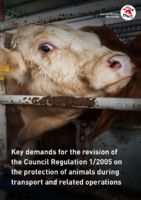
FOUR PAWS Key Demands Paper on Live Animal Transport
Read our key demands on the revision of Council Regulation 1/2005
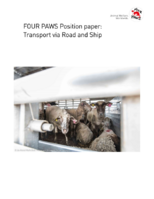
FOUR PAWS Position Paper on Animal Transports via Road and Ship
Read our position and recommendations for animal welfare improvement of animals during live transport
